
Let’s be honest. That annual IT budget meeting probably feels less like a strategic planning session and more like a battle for survival. You walk in armed with spreadsheets and justifications, knowing that every line item is under scrutiny. But the real frustration isn’t just about defending your spend; it’s about what that spend represents.
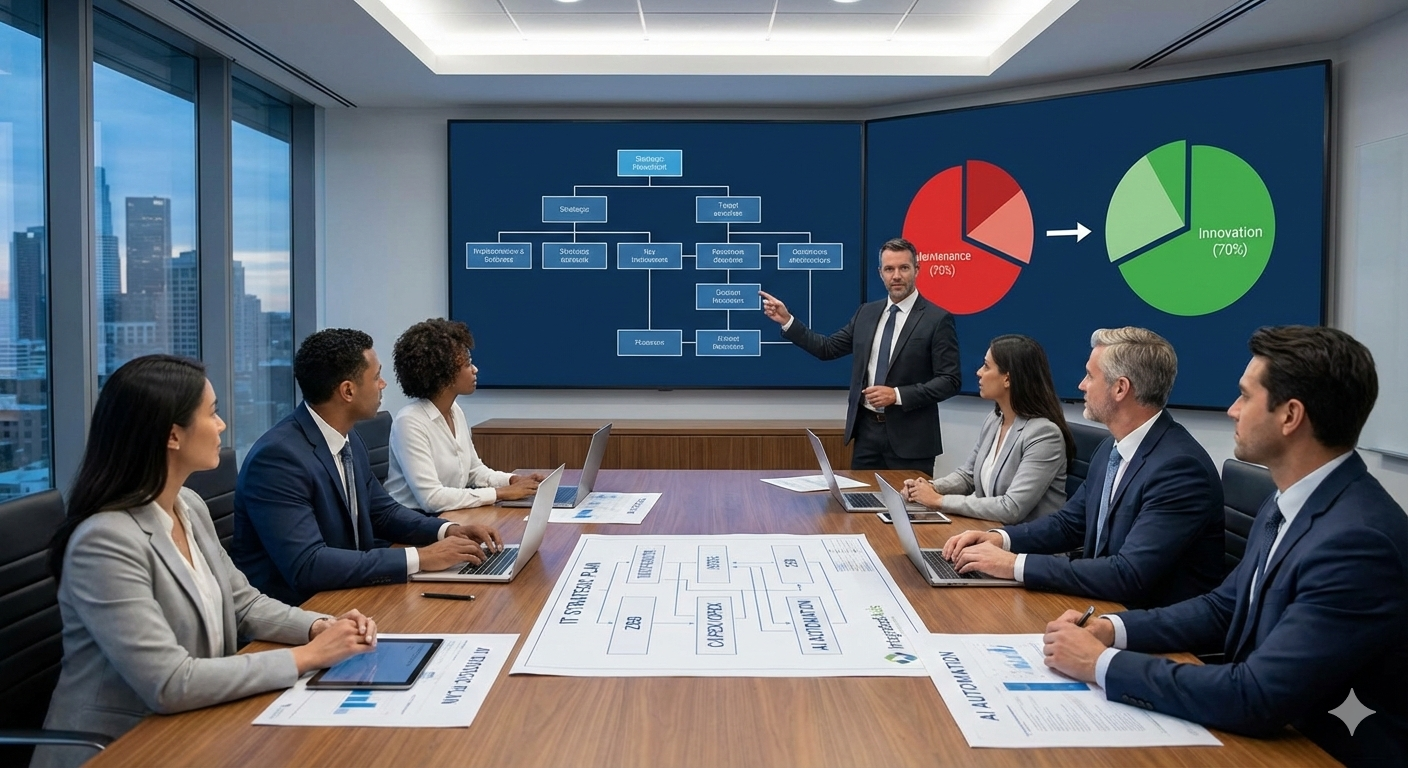
You know that feeling when you look at the final numbers? That sinking realization that the vast majority—often 70% or more—is just going to keeping the lights on. Maintenance. Licensing renewals. Legacy system support. It’s the essential but uninspiring work that consumes your resources, leaving a sliver of the pie for the projects that actually move the business forward. Innovation. Growth. Competitive advantage.
This isn’t just a budget problem. It’s an innovation bottleneck. You’re trapped in a cycle of maintaining the past instead of building the future.
But what if you could fundamentally shift that ratio? What if your next budget wasn’t just an incremental update, but a strategic blueprint for transforming your IT department from a cost center into a value-creation engine?
That’s what this guide is for. We’re not going to give you a generic list of “10 ways to cut IT costs.” You’re past that. Instead, we’re going to walk you through the strategic frameworks and modern levers you need to stop trimming the edges and start reallocating significant capital toward what matters most.
Table of Contents
- The Real Problem: Why 70% of Your IT Budget Vanishes on Maintenance
- Phase 1: Choosing Your Financial Blueprint
- Zero-Based Budgeting (ZBB) vs. Traditional Budgeting: A Decision Matrix
- CAPEX vs. OPEX: Aligning Your Spend with Business Goals
- Phase 2: The Modern Engine for Cost Reallocation: AI & Automation
- Phase 3: Tactical Optimization Across Your IT Towers
- Taming the Cloud: Eliminating the 35% Waste
- Mastering Software Licensing & Vendor Management
- Phase 4: Pitching the Budget—From Cost Center to Value Driver
- Your Partner in Strategic IT Planning
- Frequently Asked Questions (FAQ)
The Real Problem: Why 70% of Your IT Budget Vanishes on Maintenance
That 70% figure isn’t just a feeling—it’s a well-documented reality. Research from Gartner and Deloitte consistently shows that businesses spend between 55% and 72% of their IT budgets simply on maintaining current operations. This leaves a meager 19% to 28% for innovation and growth.
Think about what that means. For every dollar you spend, seventy cents goes to just keeping things running as they are. This “Keeping the Lights On” (KTLO) tax is the single biggest obstacle to digital transformation. You can’t fund a critical AI initiative, a cybersecurity overhaul, or a customer experience platform when your budget is anchored to patching servers and renewing decades-old software licenses.
The goal of modern IT budget planning isn’t just to cut costs; it’s to systematically attack that 70% and reallocate it to the 30% bucket. It’s about creating innovation capacity. And that process starts with choosing the right financial foundation.
Phase 1: Choosing Your Financial Blueprint
Before you can optimize a single line item, you need to decide on the fundamental rules of the game. How will you build and manage your budget? The two biggest decisions you’ll make are your budgeting methodology (ZBB vs. Traditional) and your financial model (CAPEX vs. OPEX).
Zero-Based Budgeting (ZBB) vs. Traditional Budgeting: A Decision Matrix
For decades, most IT departments ran on a traditional, or incremental, model. You take last year’s budget and add or subtract a few percentage points. It’s simple, predictable, and deeply flawed. It assumes last year’s priorities are still valid and it encourages hoarding budget to protect it for next year.
Enter Zero-Based Budgeting (ZBB). ZBB forces you to build your budget from scratch every single cycle. Every team, every project, every subscription must be justified based on the value it delivers to the business right now. It’s a radical shift in mindset from “What did we spend last year?” to “What do we absolutely need to spend this year to achieve our goals?”
Which one is right for you? It depends on your organization’s maturity and goals.
| Factor | Traditional Budgeting | Zero-Based Budgeting (ZBB) |
|---|---|---|
| Core Principle | Last year’s budget +/- a percentage | Start from zero; justify every expense |
| Best For | Stable, predictable environments with low variability in IT needs. | High-growth companies, businesses undergoing transformation, or cloud-heavy environments. |
| Pros | Fast, simple, requires less upfront effort. | Eliminates budget bloat, forces prioritization, directly links spending to strategic goals. |
| Cons | Perpetuates inefficient spending, hides waste, discourages agility. | Time-consuming, requires deep operational analysis, can create internal friction. |
| When to Use It | When IT functions more like a utility (e.g., maintaining stable, on-prem infrastructure). | When you need to aggressively shift spend from operations to innovation and challenge every assumption. |
For many modern businesses, a hybrid approach works best. You might use a traditional model for fixed, predictable costs like core infrastructure and a ZBB model for variable expenses like new projects, cloud services, and software development.
CAPEX vs. OPEX: Aligning Your Spend with Business Goals
The second foundational choice is how you classify your spending.
- Capital Expenditures (CAPEX): These are major, upfront purchases of physical assets that you own—think servers, networking hardware, or a perpetual software license. The cost is depreciated over the asset’s useful life.
- Operational Expenditures (OPEX): These are ongoing, subscription-based costs for services you use—think cloud computing resources from AWS or Azure, SaaS licenses for Microsoft 365, or a managed services contract. You pay as you go.
The shift to the cloud has triggered a massive migration from a CAPEX-heavy model to an OPEX-dominant one. Why? Flexibility. With OPEX, you’re not locked into a five-year hardware lifecycle. You can scale resources up or down on demand, preserving cash flow and enabling you to pivot quickly as business needs change. This agility is the lifeblood of innovation.
Choosing between them is a strategic financial decision. If you have strong cash flow and want to own and control your assets, CAPEX might make sense. But if you prioritize agility, scalability, and predictable monthly costs, an OPEX model, supported by strategic cloud computing services, is almost always the superior choice for funding growth.
Phase 2: The Modern Engine for Cost Reallocation: AI & Automation
Once your strategic foundation is set, you need a powerful engine to start shifting that 70% maintenance spend. That engine is AI and automation.
Historically, reducing operational overhead meant outsourcing or headcount reduction—both painful and often ineffective in the long run. Today, Generative AI and IT automation offer a path to systematically reduce the manual, repetitive tasks that consume your team’s time without sacrificing quality.
The numbers are staggering. A recent study by Boston Consulting Group (BCG) found that Generative AI can drive labor cost savings of around 25%, with functions like procurement seeing savings between 15% and 45%.
Think about your IT service desk. How many hours are spent on password resets, software access requests, and answering the same basic questions over and over? These high-volume, low-value tasks are prime candidates for automation. By deploying an AI-powered chatbot or an automated workflow, you can resolve these issues instantly, 24/7. This doesn’t just cut costs; it dramatically improves the employee experience.
Here’s an actionable strategy to get started:
- Identify High-ROI Targets: Analyze your service desk tickets. Isolate the top 5-10 most frequent and repetitive requests. These are your starting points.
- Quantify the Cost: Calculate the current “cost-per-ticket” for these items, factoring in the time your skilled technicians spend on them.
- Implement Automation: Deploy tools to automate these workflows. This could be anything from a simple script to a sophisticated AI platform.
- Measure and Reallocate: Track the reduction in manual tickets and calculate the ROI. Most importantly, reallocate the saved engineering hours to high-value projects like cybersecurity hardening, application development, or strategic planning.
This isn’t about replacing people; it’s about elevating them. You free your best minds from mundane work so they can focus on the complex challenges that drive the business forward. This approach is why enterprise AI budgets are projected to increase by 36% in 2025—it’s not an expense, it’s a direct investment in operational efficiency and innovation capacity. A professional IT Help Desk service can be the catalyst for implementing this level of automation.
Phase 3: Tactical Optimization Across Your IT Towers
With your strategic framework and automation engine in place, you can now turn to targeted, tactical optimizations. This is where you find and eliminate waste in your biggest cost centers.
Taming the Cloud: Eliminating the 35% Waste
The cloud promised efficiency, but for many, it has created a new kind of budget chaos. According to research from phoenixNAP, a shocking 35% of all cloud spending is wasted. This waste comes from a few common, and fixable, technical mistakes.
Here are the top culprits to hunt down:
- Oversized Instances: Engineers often provision larger virtual machines than they actually need “just in case.” Rightsizing these instances to match their actual workload is the single fastest way to cut cloud costs.
- Idle or “Zombie” Resources: These are development environments, test servers, or storage volumes that were spun up for a project and never shut down. They sit there, running 24/7, silently draining your budget.
- Poor Tagging and Accountability: Without a strict resource tagging policy, it’s impossible to know which department or project is responsible for which costs. You can’t manage what you can’t measure.
- Ignoring Savings Plans: Cloud providers offer significant discounts (up to 70%) for committing to a certain level of usage over one or three years. Failing to use Reserved Instances or Savings Plans for predictable workloads is like turning down free money.
Implementing FinOps (Financial Operations) best practices gives you the visibility and control needed to eliminate this waste and ensure every dollar spent in the cloud delivers maximum value.
Mastering Software Licensing & Vendor Management
Your second major cost center is often software and vendor contracts. This area is notorious for sprawl, redundancy, and “shadow IT”—where departments purchase their own SaaS applications without central oversight.
A thorough audit, often with the help of a Co-managed IT partner who can provide specialized tools, is the first step. You need a complete inventory of every application and license in your organization. Ask these questions:
- Is it being used? How many purchased licenses are sitting on a shelf, unassigned? • Is there overlap? Do you have three different departments paying for three different project management tools that all do the same thing?
- Are the terms still right? Can you renegotiate your contract based on actual usage or bundle services with a single vendor for a volume discount?
Consolidating vendors and creating a standardized software catalog not only saves money but also reduces complexity and strengthens your security posture.
Phase 4: Pitching the Budget—From Cost Center to Value Driver
Finally, the most critical step is changing how you communicate the budget to the C-suite. You must shift the conversation away from IT as a cost center and reposition it as a strategic driver of business value.
Don’t lead with a spreadsheet full of costs. Lead with a story about transformation.
Old Pitch: “We need an additional $200,000 for our IT budget this year to cover increased licensing costs and server maintenance.”
New Pitch: “We’ve identified a plan to reduce our operational spend by 15% through targeted automation and cloud optimization. We propose reinvesting that $200,000 into a new data analytics platform that will improve sales forecasting accuracy by 25% and directly support the company’s revenue growth targets.”
See the difference? The first is a request for money. The second is a business case.
Support your pitch with the right metrics. Instead of just tracking uptime and ticket counts, present metrics that the CFO and CEO care about:
- Innovation Spend as a % of Total IT Budget: Show how this percentage is increasing over time as a direct result of your optimization efforts.
- IT Cost per Employee: Demonstrate how you are creating efficiencies and enabling the company to scale without a linear increase in IT overhead.
- Business Value Delivered: Connect IT projects directly to business outcomes, like revenue generated, costs saved, or risks mitigated.
Your Partner in Strategic IT Planning
Transforming your IT budget from a maintenance burden into an innovation engine is a journey. It requires a clear strategy, the right tools, and a deep understanding of both technology and business finance.
For over 30 years, KME Systems has been that strategic partner for businesses across Southern California. We don’t just fix problems; we help you build a technology roadmap that aligns with your vision, mission, and values. Our approach to Managed IT Services is built on a foundation of Trust, Teamwork, and a relentless focus on your growth.
If you’re ready to break free from the 70/30 trap and build a budget that fuels your future, let’s talk.
Frequently Asked Questions (FAQ)
What percentage of revenue should a company spend on IT? While it varies by industry, data from phoenixNAP shows that companies spend an average of 7.5% of their revenue on IT. Technology-driven sectors may spend more, while more traditional industries might spend less. The key is not the percentage itself, but the return on that investment.
Is Zero-Based Budgeting too complicated for a small or medium-sized business? A full-scale ZBB implementation can be resource-intensive. However, SMBs can get most of the benefits by using a hybrid approach. Apply ZBB principles to your most significant variable cost areas, like new projects and cloud spend, while using a traditional model for more predictable, fixed costs.
How quickly can we see ROI from IT automation? You can see an immediate impact on metrics like ticket resolution times. A financial ROI, measured in reallocated staff hours and reduced operational costs, can often be realized within 3-6 months for well-defined projects like service desk automation. The long-term ROI comes from the innovation those freed-up resources produce.
Can’t we just cut costs by switching to the cheapest vendors? While vendor negotiation is important, choosing a partner based solely on the lowest price is a significant risk. Cheaper solutions often come with hidden costs in the form of poor support, security vulnerabilities, and a lack of strategic guidance. A true technology partner invests in your success and delivers value far beyond the line-item cost.